AI and Digital Marketing: A Complete Guide for Businesses
9 min read
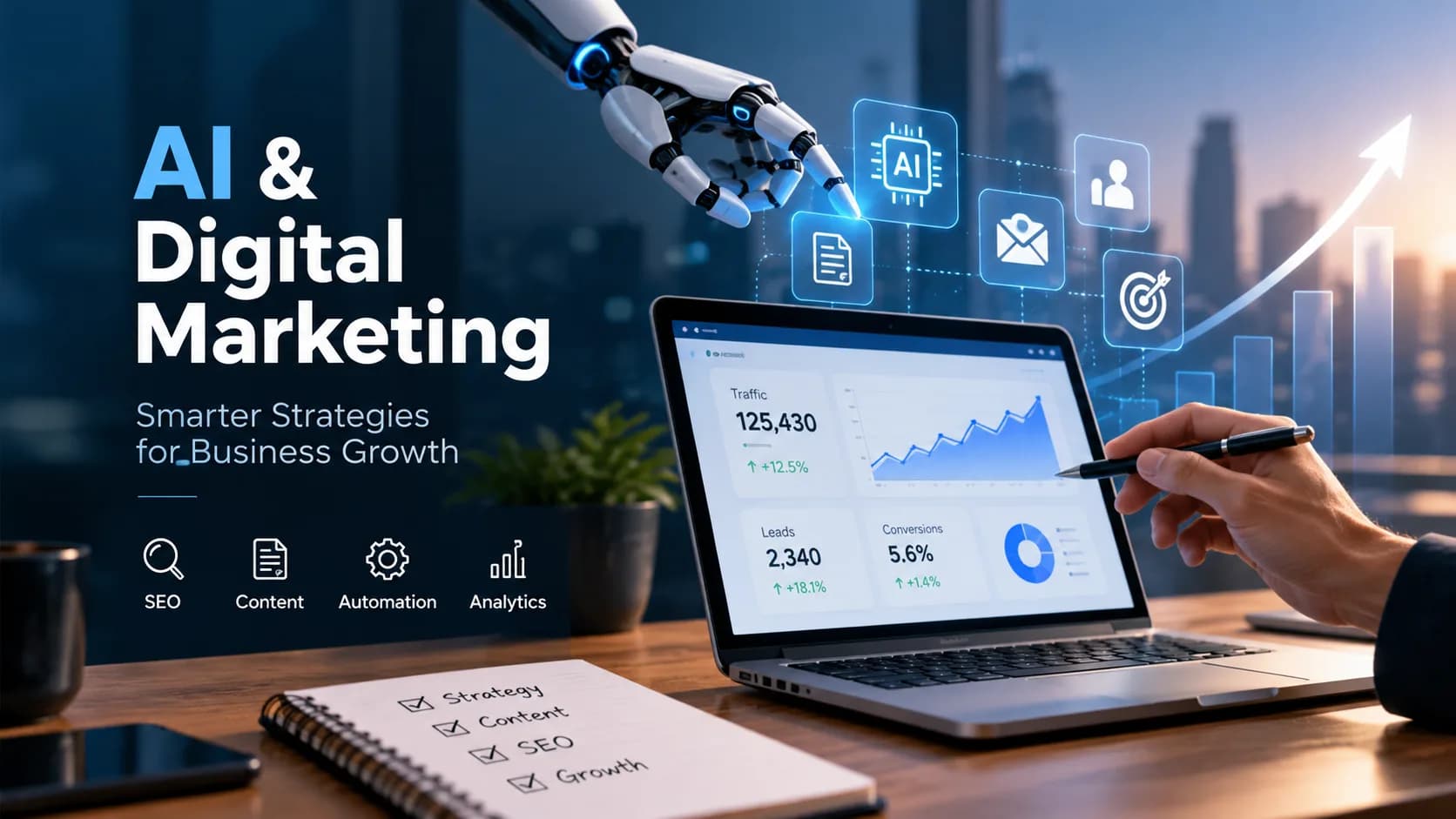
AI and Digital Marketing: A Complete Guide for Businesses
Digital competition is growing every day. Businesses need more than traditional marketing methods to attract customers, improve search visibility, and reach the right audience. This is where artificial intelligence (AI) and digital marketing come together to create new opportunities for growth.
From content creation and search engine optimization (SEO) to marketing automation and customer analytics, AI is changing how businesses plan and execute their marketing strategies.
However, success does not come from simply using AI tools. The real advantage comes from integrating these technologies into a clear marketing strategy.
In this guide, we will explore how AI is transforming digital marketing, how businesses can use it for SEO, and which practical strategies can help improve marketing performance.
1. How Is Artificial Intelligence Changing Digital Marketing?
Artificial intelligence can analyze large amounts of data, assist with content creation, automate repetitive tasks, and support faster decision-making.
Tasks that once required hours of manual work can now be completed more efficiently with the help of AI. Examples include generating content ideas, grouping keywords, drafting advertising copy, and analyzing campaign performance.
Some of the main applications of AI in digital marketing include:
- Content marketing: Developing ideas for blog posts, social media content, and advertising campaigns.
- SEO optimization: Organizing keywords, identifying content gaps, and improving article structures.
- Customer analytics: Understanding audience behavior and evaluating campaign results.
- Marketing automation: Streamlining repetitive tasks and communication workflows.
- Personalization: Creating relevant messages and offers for different customer segments.
AI can improve efficiency, but its outputs are not always accurate or appropriate. Human judgment, fact-checking, and strategic thinking remain essential.
2. SEO and AI: How to Improve Search Visibility
Search engine optimization, commonly known as SEO, is the process of improving a website's visibility in organic search results.
A well-planned SEO strategy helps potential customers discover your business when they search for relevant products, services, or information.
AI can support several parts of the SEO workflow, including keyword research, content planning, topic clustering, and identifying opportunities to improve existing pages.
Keyword Research
Start by understanding the terms your target audience uses when searching online.
For a digital marketing business, relevant keywords might include "digital marketing services," "SEO optimization," "content marketing strategy," and "marketing automation."
However, adding every keyword to a single article is not an effective strategy. Each page should focus on a clear topic and satisfy a specific search intent.
Creating Helpful Content
High-quality SEO content should answer real questions and provide useful information.
Rather than producing generic articles filled with keywords, focus on practical examples, original insights, accurate information, and clear explanations.
AI can help create an initial outline or draft, but the final article should be reviewed and improved to ensure accuracy, relevance, and originality.
Technical SEO
Even excellent content can struggle if a website has technical problems.
Important technical SEO considerations include:
- Ensuring important pages can be crawled and indexed.
- Optimizing the mobile user experience.
- Improving page speed and overall performance.
- Using a logical H1, H2, and H3 heading structure.
- Writing relevant title tags and meta descriptions.
- Creating useful internal links.
- Checking XML sitemaps and robots.txt configuration.
AI can assist with audits and recommendations, but actual website issues should be verified using appropriate technical tools.
3. AI-Powered Content Marketing
Content marketing helps businesses attract and engage audiences by publishing useful, relevant information.
Blog articles, social media posts, email newsletters, videos, and educational resources can all support a strong content marketing strategy.
AI makes it easier to develop multiple content formats from a single topic.
For example, one comprehensive blog article can become:
- An Instagram carousel.
- A short-form video script.
- A LinkedIn post.
- An email newsletter.
- Several social media posts.
This approach allows businesses to use their research more efficiently while maintaining a consistent message across different platforms.
However, content should be adapted to each platform rather than copied without modification. Blog readers may want detailed explanations, while social media audiences often prefer concise, visual, and engaging information.
The goal is not to publish more content at any cost. It is to create useful content consistently and distribute it effectively.
4. How Small Businesses Can Benefit from AI
Artificial intelligence is not limited to large corporations. Small and medium-sized businesses can also use AI to improve their marketing operations.
Social Media Management
AI can help develop monthly content calendars, suggest post ideas, and draft captions that match a brand's communication style.
Customer Support
Chatbots can answer frequently asked questions, provide information about products or services, and direct inquiries to the appropriate team.
Advertising Campaigns
AI can generate alternative advertising messages, support audience research, and help analyze campaign results. Actual performance should be measured through testing and reliable campaign data.
Market and Competitor Research
AI can summarize publicly available information, organize competitor content, and identify potential topics for further investigation.
For small businesses with limited time and resources, these applications can reduce repetitive work and create more time for strategic decisions.
5. Marketing Automation: Save Time and Improve Efficiency
Marketing automation uses predefined workflows to perform repetitive marketing tasks automatically.
For example, when a potential customer submits a contact form, the business can send an automatic confirmation email, record the inquiry in a CRM system, and notify the relevant sales representative.
AI can enhance these workflows by helping categorize inquiries, draft personalized responses, and summarize customer interactions.
However, automation should begin with a clear understanding of the existing process. Automating an inefficient workflow may simply reproduce the same problems more quickly.
Businesses should first identify their operational needs, select suitable tools, and measure the results after implementation.
6. Will AI Replace SEO Specialists?
AI can perform or accelerate many SEO-related tasks, including keyword grouping, content outlining, initial drafting, and data summarization.
However, effective SEO involves much more than producing text.
It requires understanding business objectives, analyzing search intent, evaluating competition, solving technical problems, and making decisions based on performance data.
AI can also generate inaccurate information or produce content that lacks originality and context.
For this reason, SEO professionals who combine AI tools with analytical thinking, creativity, and business strategy can remain valuable in an increasingly automated environment.
The future of digital marketing is not simply about AI replacing people. It is about people using AI effectively to improve the quality and efficiency of their work.
7. How to Build an AI-Driven Digital Marketing Strategy
Businesses do not need to implement every AI tool at once. A more effective approach is to start with a specific business objective and expand gradually.
Step 1: Define your goals.
Decide whether you want to increase organic traffic, generate more leads, improve conversions, or reduce the time required to produce content.
Step 2: Analyze your current performance.
Review your website traffic, search visibility, social media engagement, and customer acquisition process. Establish baseline metrics before making changes.
Step 3: Choose the right AI tools.
Select tools that address specific needs, such as content development, SEO research, analytics, design, or workflow automation.
Step 4: Develop a content strategy.
Identify your audience's questions, prioritize relevant topics, and create a realistic publishing schedule. Every piece of content should have a clear purpose.
Step 5: Measure and improve.
Use Google Search Console and suitable analytics tools to monitor search performance, user behavior, and conversions.
SEO results take time, so evaluate progress consistently rather than expecting immediate improvements.
8. Can AI-Generated Content Rank on Google?
Yes. AI-assisted content can rank in Google Search when it provides genuine value and satisfies users' needs.
The important consideration is not simply whether AI was used, but whether the content is helpful, reliable, relevant, and created with an appropriate level of care.
Content produced at scale primarily to manipulate search rankings, without providing meaningful value, can violate Google's spam policies.
To improve content quality:
- Answer specific user questions.
- Verify facts using reliable sources.
- Include practical examples and original insights.
- Organize information with clear headings.
- Avoid unnecessary keyword repetition.
- Review the content from the reader's perspective.
A successful SEO strategy focuses on satisfying search intent rather than simply inserting keywords into a page.
Conclusion: The Future of Marketing Combines Technology and Strategy
Artificial intelligence creates new opportunities for businesses to improve content production, support SEO, streamline marketing workflows, and better understand customer behavior.
However, technology alone does not guarantee success. Clear objectives, reliable information, useful content, customer understanding, and continuous optimization remain essential.
If you want to improve your business's digital presence, begin by identifying the problem you need to solve. Then choose the tools and strategies that can help you achieve measurable results.
When implemented thoughtfully, AI becomes more than a productivity tool. It becomes a valuable resource for making smarter marketing decisions and building sustainable business growth.
Frequently Asked Questions
What is AI in digital marketing?
AI in digital marketing refers to using artificial intelligence to support tasks such as content creation, SEO research, customer analytics, advertising, personalization, and marketing automation.
Is AI useful for SEO?
Yes. AI can help with keyword research, content planning, topic analysis, and content improvement. Technical SEO and strategic decisions still require appropriate expertise and verification.
Can AI-generated blog posts rank on Google?
Yes. AI-assisted articles can rank when they provide useful, reliable, and relevant information. Low-quality content created primarily to manipulate rankings may violate Google's spam policies.
Can small businesses use AI marketing tools?
Yes. Small businesses can use AI for social media planning, content creation, customer support, market research, and repetitive workflow automation.
Does AI guarantee better marketing results?
No. Results depend on the strategy, audience, quality of the data, implementation, competition, and market conditions. Testing and measurement are essential.